
Skip to content Skip to main navigation Skip to footer

News

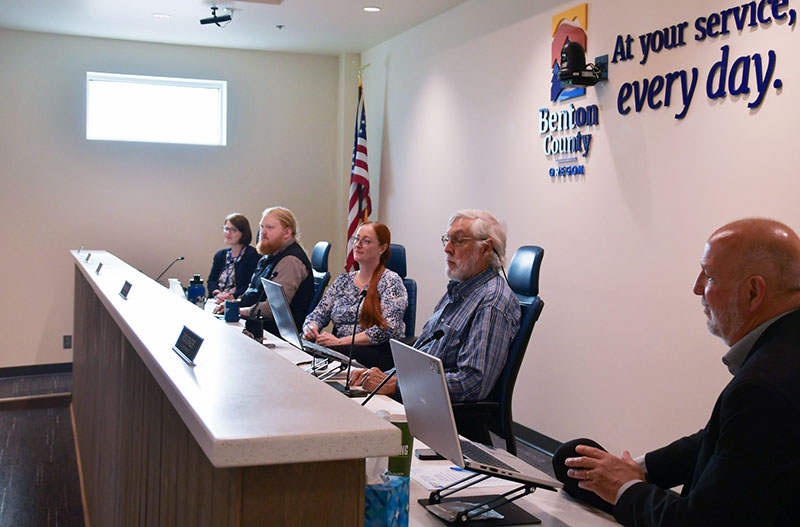
The Board of Commissioners, County Counsel and County Administrator on the dias

County to continue using vendor for Benton Area Transit services

In a Nov. 16 meeting, the Benton County Board of Commissioners voted unanimously to continue working with a contracted vendor to provide Benton Area Transit services. The new contract period will begin Jan. 1, 2028.

Last December, the Board directed staff to develop a plan for internal delivery of transit services. A project team spent 10 months working on the self-performance model.

At the same time, the team explored what would need to be added to the current contract to ensure detailed reporting and accountability in the future. Both are needed to meet changing requirements for the federal funding that supports BAT services.

Once both plans were developed, it was up to the Board of Commissioners to choose which option staff should pursue in developing the 2027-29 biennial budget, and which would be saved as Plan B. The backup option would be ready to quickly implement if needed to ensure continuity of services.

In a Nov. 10 work session (timecode 12:30) during the Board of Commissioners Goal Setting meeting, the BAT project team presented updated cost estimates to the Board along with the strengths and limitations of each plan.

The presentation included a staff recommendation: to continue operating the service with a vendor, under contract terms written to ensure increased accountability and rigor by both the vendor and the County.

What changed?

In December 2025, the Board of Commissioners was presented with a recommendation to develop a self-performance plan for Benton Area Transit. A program analysis conducted by transportation consultant Kittelson & Associates pointed to self-performance as a better way to address concerns about reporting compliance, adapt to frequently changing federal and state requirements and increase opportunities to provide expanded services.

Less than a year later, the staff’s recommendation was to not begin implementing the self-performance plan they had just developed. Instead, they encouraged the Board to continue using contracted service providers, but with new clauses in the contract and more oversight.

The second recommendation does not contradict the first.

“Remember, in 2025 the Board didn’t vote to implement a self-performance model—they directed us to develop a plan for one,” said Public Works Director Gary Stockhoff. “For years, the County has operated BAT without a contingency plan. If there was an emergency or unexpected event, we had no backup plan.”

County Administrator Rick Crager reinforced the importance of being prepared for uncertainty.

“Responsible governance requires us to be able to assure continuity of operations. Having a Plan B reduces risk for everyone involved. Community members won’t suddenly lose services because we’re unprepared. The County won’t suddenly lose funding.  It’s a great outcome from this whole process.”

Nick Metzger from Kittleson & Associates explained to the Board on Nov. 10 that funding was a factor in the new recommendation. When the first recommendation was made in Dec. 2025, State Transportation Improvement Funding—the money that pays for BAT services—was expected to double no later than the next legislative session. That didn’t end up happening.

Without the expected funding increase, the best way to maximize the dollars the County does have is through a competitive procurement process. When the County issues a Request for Proposals, potential vendors can compete for a contract to provide the most effective service possible with the funds available.  

Adding a dedicated transit coordinator to the County’s workforce was another change that tipped the scales in favor of continuing to contract out. Maya O’Neal joined the Benton Area Transit team in March 2026. Within two months, her positive impact on contract management, data collection and reporting was clear.

“Having a Benton County staff person here to administer BAT, instead of relying on an agreement with staff employed by another agency, has made a huge difference,” said Crager. “That alone was a significant improvement because it positions us to have the accountability and oversight we need. We’re in a better place to effectively manage our contracts.”

The County hopes to increase staffing to administer Benton Area Transit. A position for a second full-time employee to work with O’Neal has been put forth for consideration for the 2027-29 budget.

Next steps

Building the 2027-29 budget, with a contract for BAT services included, is the next step. This work will continue for several months. The recommended budget will be considered, modified and approved by the Budget Committee in April and May in a series of public hearings.

The final budget will be considered and adopted by the Board of Commissioners in June. It will then take effect on July 1, 2027.

Because the procurement process takes several months, the Request for Proposals for the new Benton Area Transit contract will be released early in 2027, before the budget is adopted, with an intended service start date of January 1, 2028. Vendor selection is expected to happen in summer 2027, with the contract negotiated in the fall.

Visit the Benton Area Transit Service Delivery project for more information.
Rural Shuttle Feasibility Study

Benton Area Transit (BAT) is exploring the feasibility of a rural shuttle service to better serve outlying residents in Benton County (that are currently only served by limited intercity fixed routes and dial-a-ride for seniors and people with disabilities only) and increase their public transportation connections to basic services and urban centers. The project involves analyzing existing conditions, engaging the public, and determining potential routing and cost of various shuttle options.

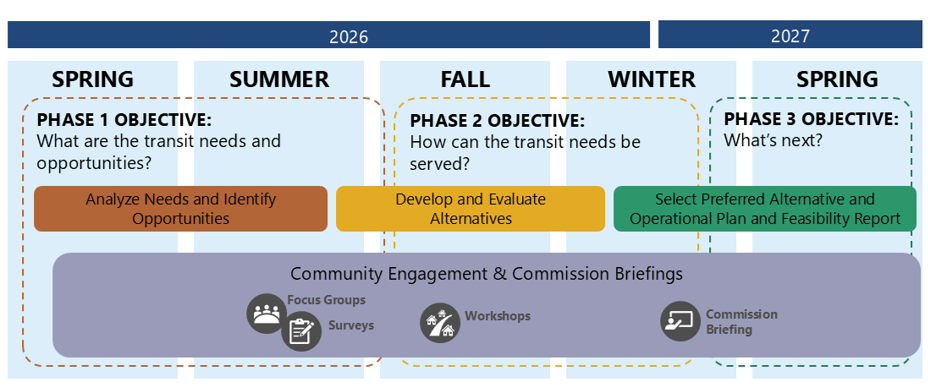
Phases

  • Phase 1 includes focus groups and an online survey to gather feedback on transit needs and opportunities.
    • An online survey was conducted from July 24 – August 11, 2026
    • In-person focus groups were hosted on July 29, 2026
  • Phase 2 includes workshops to gather feedback on draft alternatives.
    • Workshops scheduled on November 18th in Monroe and Alsea. If you are unable to attend, please use the survey link to leave comments. Survey will be open until November 30th.
  • Phase 3 includes commission briefings to gather feedback on the draft operational plan and feasibility report.

Timeline

Public Involvement

Focus groups were held at the Alsea Public Library and the Monroe Community Library on the afternoon and evening of Wednesday, July 29, 2026. The purpose of the focus groups was to gather more focused feedback than a survey would typically allow by providing space for more detailed conversation and follow-up questions from a group of key stakeholders.

Key findings from the online survey and in-person focus groups included:

  • The top barrier to transit use is where transit is provided. Other common barriers include the service frequency, lack of eligibility for demand-response service, and lack of awareness of existing services.
  • The top destinations respondents would use transit to reach are grocery stores and nonemergency medical facilities. Other commonly selected locations include shopping/ retail centers, recreational destinations, libraries, schools, and workplaces.
  • Corvallis and Philomath were listed as the locations most useful for providing shuttle service, with Albany and Alsea as the next most popular options.
  • Overall, respondents are most interested in weekday service. The midday time period (9AM-3PM) is the most popular time period for shuttle use.
  • The frequency of shuttle service needed varies between existing riders and non-riders.
  • For a more regional service, 55 percent of respondents would be willing to pay at least $3–$4 per ride.

Supporting Documents

99 Vine: your valley, your ride

County seeks new transit funding following successful 99 Vine pilot project

Benton County is calling the 99 Vine bus service pilot project, which ended June 30, a definite success. After testing a new bus route along the 99 West corridor for seven months, the County has data demonstrating the demand for future service connecting local cities with Eugene.

The pilot launched in November 2025 as a partnership between Benton and Yamhill Counties. It was supported by the Oregon Cascades West Council of Governments, with funding from the Statewide Transportation Improvement Fund (STIF) discretionary program.

The pilot route started in McMinnville with stops along Highway 99 in Amity, Rickreall, Monmouth, Adair Village, Downtown Corvallis, OSU, Monroe, Junction City and Eugene, including Eugene Airport and Amtrak station and the University of Oregon campus.

Benton and Yamhill Counties contracted with Pacific Crest Bus Lines to provide the fareless service. Buses made four trips in each direction every weekday.

The pilot route was designed with multiple age groups in mind. It connected people in small communities to more opportunities. Islands of service in rural communities were connected into a more robust, user-friendly transit system.

Limited service continuing throughout fiscal year 2027

Pacific Crest will continue to provide one ticketed trip per day, seven days a week, on a modified 99 Vine route. Originating in Coburg before passing through Eugene, it now extends north to Union Station in Portland on Highway 47. Fares, schedules and stop information are available at 99vinebus.com.

Planning for future service

Ridership data collected during the seven-month pilot show strong use of the bus service, with the greatest number of riders on Fridays. The most popular stop on the route was at Oregon State University in Corvallis. The segment of the route connecting Corvallis with other transportation — Eugene Airport, Amtrak and Transit (LTD) — was used heavily.

Benton County will use these data to guide the development of future bus service. The County has applied for state funding to provide service on a similar route starting July 1, 2027. The results of the application should be known by the end of December.

If the service is funded, it will operate under a new name, as Pacific Crest will continue to use the name 99 Vine over the next two years.

99 Express adding new stops along NE Elliot Circle, Lewisburg

Heads up, 99 Express riders!

BAT will be adjusting its 99 Express service to include 2 NEW stops in the Lewisburg area. Both new stops will be located along NE Elliot Circle, serving the areas adjacent to the Knoll Terrace Community and Mountain View Elementary. These stops will replace the old stops along Highway 99W.

In order to ensure that we are able to efficiently provide service, stops and their locations are subject to change.

For more information call our dispatch at 541-766-6700.

Integration with Amtrak

Are you planning to take the train? Let Benton Area Transit take you to the station! You can now book a train ticket directly to or from Corvallis, OSU, Philomath, Toledo, or Newport. Our Coast to Valley Express service is now an extension of the national passenger rail system. Just head over to Amtrak.com to book your ride.

Federal Mask Requirement Lifted for Public Transportation

As a result of a court order, effective immediately and as of April 18, 2022, the Center for Disease Control and Prevention’s (CDC) January 29, 2021 Order requiring masks on public transportation conveyances and at transportation hubs is no longer in effect. Therefore, CDC will not enforce the Order. CDC continues to recommend that people wear masks in indoor public transportation settings at this time.

In addition, effective immediately, the Transportation Security Administration (TSA) will not enforce its mask-related Security Directives. TSA is also withdrawing its Security Directive 1582/84-21-01E, which was issued on April 15, 2022, and was scheduled to take effect today.

In connection with the federal mask requirement begin lifting, ODOT Public Transportation Division would like to add that the March 11, 2022 letter from the Oregon Health Authority on mask mandates no longer requires general indoor masking requirement but does not prohibit a governmental entity, business, or workplace from requiring that individuals wear masks. Individuals who wish to continue to wear masks to protect against COVID-19 are free to do so.

Back to top